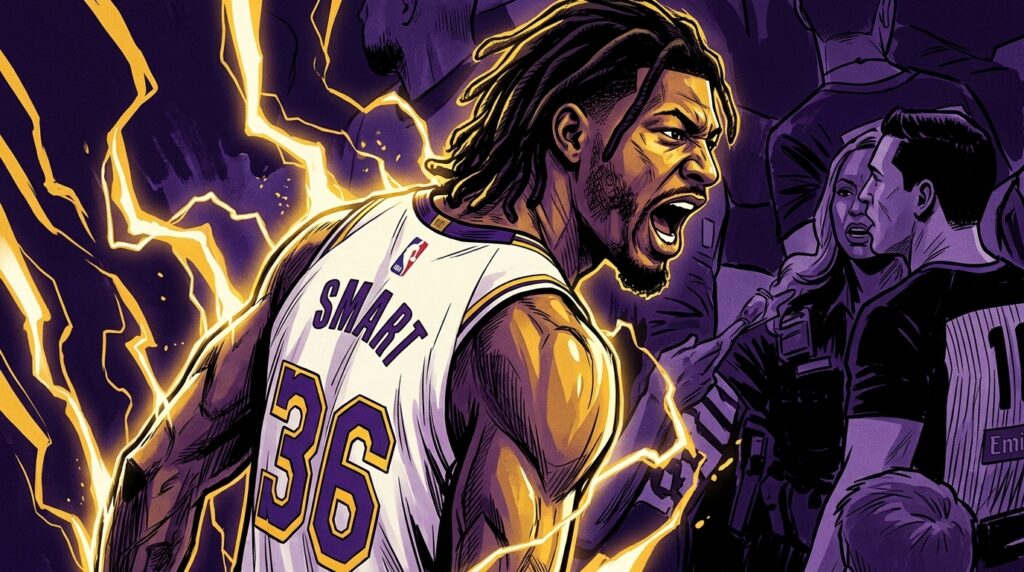
Marcus Smart said “We all understood it was some BS, right?” after Game 4 of the Lakers-Rockets series, and the NBA responded by fining him $35,000 for “questioning the integrity of game officials.” That’s the official language. Sit with it for a second. Questioning the integrity of game officials. As if the officials have integrity to protect.
The Lakers lost Game 4 by 19. Rockets lead the series 3-1. Three players — Deandre Ayton, Adou Thiero, and Aaron Holiday — were ejected in the final 1:11 of a game that was already decided. LeBron James called Thiero’s ejection “uncalled for” and “ridiculous.” LeBron paid nothing. Smart said “some BS” and got hit for thirty-five grand. Luke Kennard also chipped in $25,000 for his role in the same incident. Sixty thousand dollars, total, for a Lakers team that just got their playoff run effectively ended in circumstances that the entire building apparently recognized as a mess.
“We All Understood It Was Some BS”
Smart’s initial one-word reaction to James Williams’ officiating during the game was “Hilarious.” That’s not a threat. That’s not a slur. It’s a man watching something absurd unfold in real time and naming it accurately. The NBA’s position is that this kind of honesty — honest, public, plainspoken honesty — constitutes a danger to the league.
It doesn’t. What it constitutes is a danger to the fiction the league needs to maintain.
The fine system has existed for decades, with player fines for referee criticism ranging anywhere from $15,000 to well north of $50,000. The whole architecture of it is designed to keep players financially deterred from saying out loud what everyone in the building can already see. Fans at home see it. Coaches see it. Other refs see it. ESPN’s coverage of the Lakers-Rockets series made it plain enough. The only people the NBA wants pretending not to see it are the players, because the players are the ones with the megaphones.
The Fine Stays Even When the Call Gets Overturned
Here’s where the Booker precedent becomes genuinely damning. Earlier in these same 2026 playoffs, referee James Williams — the same James Williams who worked Game 4 of Lakers-Rockets — was at the center of a separate incident involving Devin Booker. Booker was fined $35,000. The NBA subsequently rescinded the underlying technical foul, formally acknowledging that the call was wrong.
They kept the fine.
Let that process fully land: the NBA looked at the evidence, decided the referee had made a mistake, corrected the official record — and still extracted $35,000 from the player who had the nerve to react to it. The integrity of game officials, apparently, must be protected even after the league has officially determined those officials were wrong. This is not a loophole. This is the system functioning exactly as it was designed to function. The fines were never about accuracy. They were always about silence.
LeBron Said the Same Thing and Didn’t Pay a Dime
LeBron James called an ejection “uncalled for” and “ridiculous” on the record, in public, after the same game where Smart said “some BS.” LeBron walked. Smart paid. There’s no clean explanation for why those two outcomes diverge — no clear distinction in the language used or the intent behind it. What there is: Marcus Smart has a long history of calling officiating exactly what he sees it as, and the league has a long history of billing him for the privilege.
Smart signed a two-year, $11 million deal with the Lakers in July 2025. Thirty-five thousand dollars is real money even at that salary, and more importantly, the cumulative effect of repeated fines is the point. You don’t fine players to punish them once. You fine them to make them do the math every time they feel the urge to open their mouth.
Smart should have kept the receipt on this one. Not as proof he was wronged — he knows he was wronged, the whole building knows he was wronged — but as a reminder that the NBA’s officiating accountability structure runs exactly one direction. Refs make mistakes and face no public consequences. Players notice mistakes and face financial ones. That’s not integrity protection. That’s institutional cowardice dressed up in official language.
The NBA has fined two Lakers players following Game 4 vs. the Rockets:
$35,000 for Marcus Smart for "questioning the integrity of game officials."
$25,000 for Luke Kennard for "directing inappropriate language toward game officials." pic.twitter.com/7NGNeT5ZtS
— ClutchPoints (@ClutchPoints) April 28, 2026
The NBA will keep calling it “protecting the integrity of game officials” until someone makes it expensive for them to keep saying it with a straight face.