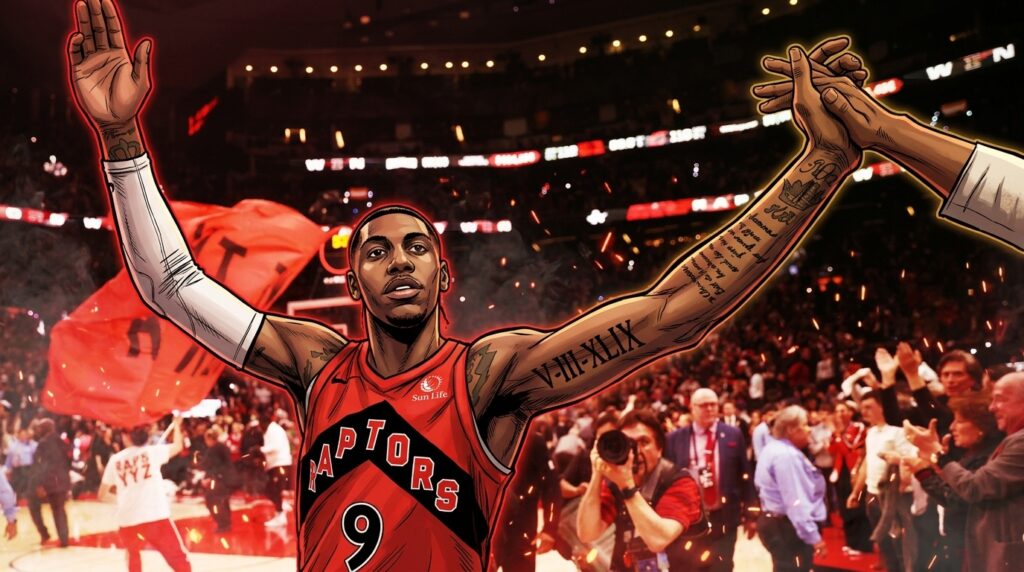
Nine-for-twenty-five. That’s RJ Barrett’s Game 7 line, and it tells you everything and nothing at the same time. The Cavaliers won 114-102, and the Raptors flew home knowing they’d pushed a better-seeded team to the wire — Jarrett Allen with 19 rebounds, Donovan Mitchell doing Donovan Mitchell things, James Harden reminding everyone he still exists — but the final buzzer doesn’t care about moral victories. What it does is hand Bobby Webster the most complicated summer of his tenure, with a 25-year-old Mississauga native at the center of every possible scenario.
Barrett’s contract situation is no mystery: he’s in the final year of a four-year, $107 million extension, and he becomes an unrestricted free agent after 2026-27. That makes him the most valuable trade chip in Toronto right now, which is an odd thing to say about a guy who averaged 24.1 points, 7.0 rebounds, and 4.0 assists through seven playoff games while connecting at 38.6% from three. He hit a buzzer-beater in Game 6 that caromed off the back of the rim and somehow found the net — the kind of play that gets compared, gently and briefly, to 2019 bounces in this city. Then he came back and went 9-for-25 in Game 7. Both of those things are true, and they capture the permanent RJ Barrett tension precisely.
Scottie Barnes Is the Foundation — Barrett Is the Question
Scottie Barnes was something else in this series. Per aggregated series averages, he put up 24.1 points, 6.1 rebounds, and 8.6 assists across all seven games — Game 3 he had 33 and 11, and Game 6 he played 47-plus minutes in overtime and finished with 25 points, 7 rebounds, and 14 assists. He’s 24 years old. He shot 57% in Game 7 while Barrett was forcing shots into a collapsing Cleveland defense that had apparently decided Barrett was the guy they could live with taking. Barnes is the unambiguous franchise piece. That’s settled.
Which means Barrett’s role is inherently secondary, and the question isn’t whether that’s okay — it is okay, most teams would trade their soul for a 1-2 punch like this — but whether the Raptors are actually built to compete at the level this core deserves. Webster himself pointed to the team’s defensive identity after the series: “Clearly, the defensive ability of [Barnes and Murray-Boyles] is special… You could surround them with more defense…” That’s not an accident. Collin Murray-Boyles was a key piece of the league’s top-five defense this season, and Immanuel Quickley missed the entire first round. The infrastructure is real.
But here’s what the Eastern Conference just taught them: infrastructure isn’t enough. Jarrett Allen had 19 rebounds in Game 7. The Raptors do not have a Jarrett Allen. They do not have anyone close to Jarrett Allen. Barrett’s expiring deal is worth approximately one Jarrett Allen on the trade market, if the front office is willing to pull the trigger.
The Knicks did the opposite. They extended Mikal Bridges to a $150 million deal and then benched him in the playoffs when the games actually mattered. That’s what happens when you commit to a secondary star without a clear picture of how he fits the hierarchy. Webster has watched that cautionary tale play out in real time, from a city two hours down the 401.
What Bobby Webster Does Next Defines This Rebuild
The public facing version of Webster’s thinking, delivered at exit interviews, was a masterwork of productive ambiguity. Webster told reporters he’s had conversations with Barrett throughout the season and at the end, and that “the good thing is he’s under contract, so that’s also something we can talk about at the end of next season.” In the annals of front-office non-answers, that one deserves a plaque. He said the quiet part loud and then made it quieter again.
There are three actual paths here, not two. Webster can trade Barrett this summer while his value is peak — a 25-year-old playoff scorer on an expiring deal will have suitors — and accelerate the contention window around Barnes with a rim protector and whatever else comes back. He can extend Barrett before free agency and commit to this core, knowing the fit questions don’t magically disappear but the continuity argument is real after a 16-win improvement and a playoff run that nobody expected to look like this. Or he can do exactly what he implied: let Barrett play out his final year, collect information, and make the call in 2027 with a full season of data.
That third option sounds cautious to the point of cowardice. It also might be the right answer.
Barrett’s own exit interview didn’t leave much ambiguity about where he stands emotionally. “I’m from here,” he said at his exit interview, “and who doesn’t want to play at home? So of course, I’m trying to stay here. I understand the business. I want to stay here. I want to be here for the rest of my career. I don’t ever want to leave.” A Mississauga kid saying he never wants to leave Toronto — that lands differently than a guy from Phoenix saying nice things about the market. It’s genuine, and it probably makes trading him at least 15% harder than it would otherwise be.
Barrett also said the decision is “out of my control” and that he’s “done my part on the court.” He’s right on both counts. The 9-for-25 in Game 7 matters, but so does what he built across 57 regular season games at 49.1% shooting and a playoff run where he was, more nights than not, the second-best player on a team that pushed a first-round favorite to seven games. Webster has to weigh all of it — the efficiency questions, the fit with Barnes long-term, the emotional calculus of trading the city’s own guy.
Barnes put it his own way after the series: “I don’t know about successful. I felt like we went out there every single game and just got better.” That’s the operative frame. This team got better. The question is whether getting better requires Barrett, or whether the best version of this roster exists without him.
Webster won’t answer that until he has to. The rest of us are going to be arguing about it all summer.