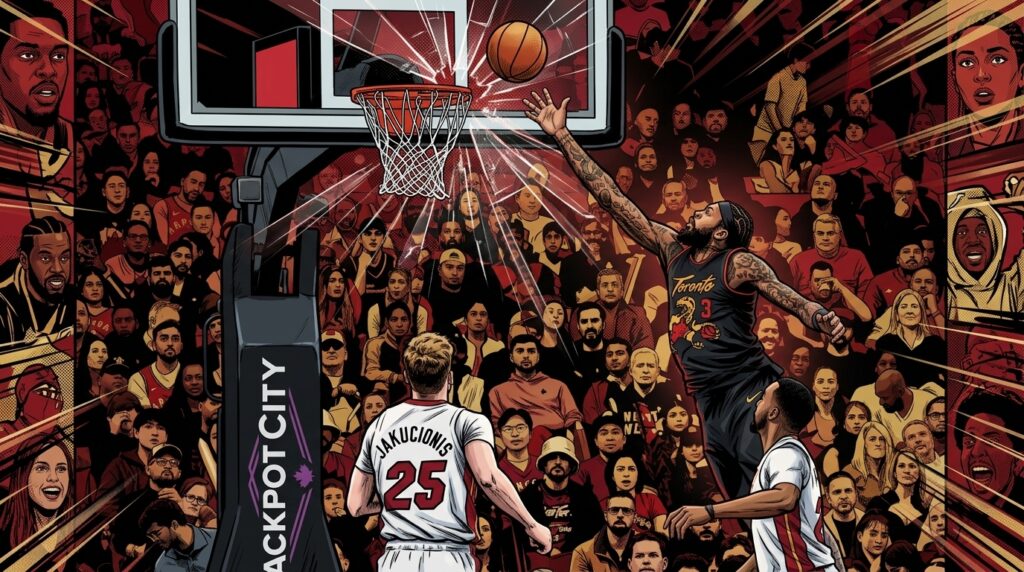
With 1.2 seconds left in overtime of Game 6, RJ Barrett caught, gathered, and released a 3-pointer that caromed high off the rim and dropped through the net and kept Toronto’s season alive. Reportedly the first player in NBA history to hit a game-winner in the final two seconds of overtime to avoid elimination. Game over. Series tied. Building explodes. And somewhere in the back of every Raptors fan’s brain, a different kind of clock started ticking.
Barrett made his case in the most dramatic way possible:
RJ Barrett is the first player in the play-by-play era (since 1997-98) to hit a game-winner in the final 2 seconds of OT to avoid elimination 🔥pic.twitter.com/PEqtBA648X
— ESPN Insights (@ESPNInsights) May 2, 2026
That’s not a guy you trade away in the summer. But the cap sheet doesn’t care about moments.
We spent all of last week arguing that Barrett’s contract was the only offseason question that mattered. Turns out the question also has a name: Brandon Ingram.
The Math Doesn’t Add Up
The top five alone — Scottie Barnes (~$41.7M), Ingram ($40M), Immanuel Quickley ($32.5M), Barrett ($29.6M), Jakob Poeltl (~$19.5M option) — consumes roughly $163.4M against a projected $165M cap. That’s five players eating nearly the entire ceiling before you’ve filled out a rotation, signed a backup point guard, or addressed a single bench hole. The cap arithmetic has been brutal all offseason, and it only gets more uncomfortable from here.
The decision essentially writes itself as a binary: move Ingram and extend Barrett, or extend Ingram and let Barrett walk in unrestricted free agency. There is no clever third path that makes both contracts fit. Masai Ujiri has never been one for false choices, but even he can’t negotiate with arithmetic.
Both Scenarios Are Uncomfortable
Trade Ingram, and you’re selling a 28-year-old former All-Star at his lowest value, one year removed from a 21.5 PPG regular season on 47.7% shooting. You’ll get back something — probably a pick package and a smaller deal — but the return almost certainly won’t match what he costs on paper. Multiple analysts have noted that his playoff performance tanked his leverage, which paradoxically hurts Toronto too: teams know they can low-ball a team that has to move a guy who just averaged 12.0 points on 32.8% in five games before missing Games 6 and 7 with a heel spur.
Ingram acknowledged the weight of it. “It’s hard, you know? It’s tough, when you go back and you’re not doing your job, especially what they brought you here to do.” That quote will bounce around Raptors Twitter for the next four months.
Keep Ingram, extend him — and you’re letting Barrett walk after a playoff run where he went 33 points in Game 3, 25/12/5 in Game 5, the game-winner in Game 6, then 23 points and 6 assists in the Game 7 loss even as the offense collapsed around him. His numbers didn’t fall off. The team around him fell apart. Barrett himself has been direct: “Toronto is home for me. I think I play with a little bit of a different passion.” That’s not a negotiating tactic. That sounds like someone who wants to be there.
The wrinkle is that GM Bobby Webster isn’t treating this as an emergency. His public stance on Barrett’s extension: “The good thing is he’s under contract, so that’s also something we can talk about at the end of next season.” Which is either a measured front-office signal that they’re not panicking — or a tacit admission that the Ingram question has to resolve first before anyone knows what’s left for Barrett.
Worth noting: Ingram’s 2027-28 year is a player option, not a guaranteed contract. If he declines it after a bounce-back season — entirely plausible for a guy who just had heel surgery at 28 — the Raptors could end up having made neither decision and simply had the choice yanked away from them.
The Raptors pushed Cleveland to seven games with a roster that played measurably better without one of its highest-paid players in Game 6 — even if Game 7, also without Ingram, ended in a 12-point loss. One game doesn’t prove a theorem. Two games, split, still forces the question. That is not a comfortable thing to sit with when you’re writing checks. Webster’s public posture reads as calculated delay — “we can talk about it at the end of next season” — but front offices don’t usually get credit for deferring decisions the film has already made for them.